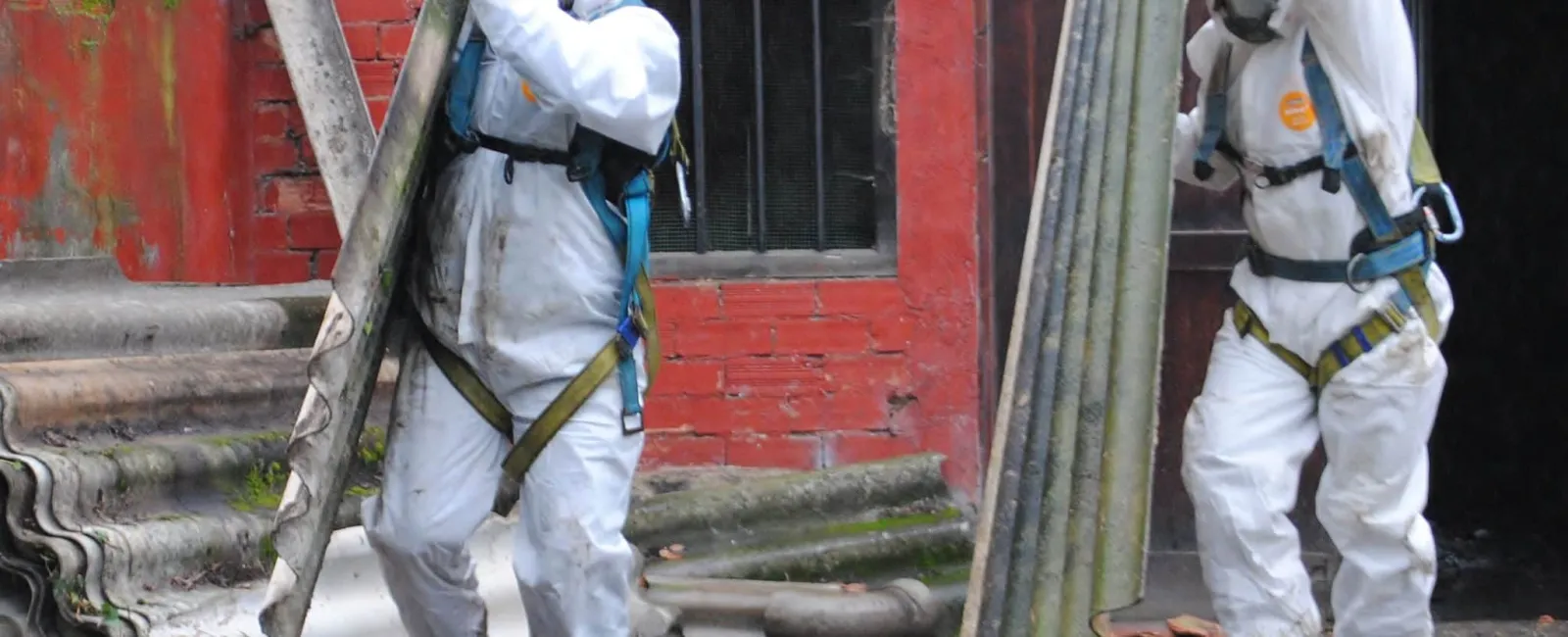
Asbestos was widely used in
commercial construction through the late 1970s, valued for its fire resistance,
insulating properties, and durability. It appeared in floor tiles, pipe
insulation, roofing materials, ceiling texture, joint compound, fireproofing,
and dozens of other building products. The EPA estimates that roughly 20
percent of all public and commercial buildings in the United States contain
some asbestos-containing material.
That statistic matters most when a property is being acquired, renovated, or demolished. In those scenarios, an asbestos survey is not a precaution; for most commercial projects, it is a regulatory requirement.
What Is an Asbestos Survey?
An asbestos survey is a
systematic inspection of a building or structure performed by licensed
professionals to identify the presence, location, type, quantity, and condition
of asbestos-containing materials (ACMs). Visual identification alone cannot determine
whether a material contains asbestos; laboratory analysis of collected samples
is required for confirmation.
The survey produces an asbestos
register: a documented inventory of all identified and presumed ACMs, including
their locations, conditions, friability classifications, and recommended management actions. This register is the foundation for regulatory compliance,
pre-demolition permitting, abatement planning, and ongoing operations and
maintenance programs.
Asbestos surveys must be conducted by accredited professionals trained in sampling methodology, personal protective equipment, and chain-of-custody procedures. Laboratory analysis must be performed by an NVLAP-accredited laboratory. NOVA's environmental consulting team conducts asbestos surveys with NVLAP-accredited laboratory support across Georgia, Florida, North Carolina, and South Carolina.
The Two Types of Asbestos Survey
The appropriate survey type depends on the intended use of the building and the nature of any planned work.
|
Survey Type |
When Required |
Scope |
Key Deliverable |
|
Management
Survey |
Occupied
buildings; no demolition/renovation planned |
Non-intrusive;
presumed ACMs noted |
Asbestos
register and O&M plan |
|
Demolition/Refurbishment
Survey |
Pre-demolition;
pre-renovation disturbing materials |
Fully
intrusive; destructive sampling required |
Complete ACM inventory; clearance for permit |
Management Survey
A management survey is the
baseline assessment for occupied commercial buildings where no renovation or
demolition is planned. Its purpose is to locate all ACMs that could be damaged
or disturbed during normal occupancy, maintenance, or minor repairs. The survey
is largely non-intrusive: the surveyor inspects accessible areas and collects
samples from suspect materials. Areas that cannot be accessed are presumed to contain ACMs and are managed accordingly.
The deliverable is an asbestos
register and, typically, an operations and maintenance (O&M) plan that
governs the management of identified ACMs in place. Management surveys satisfy
OSHA and AHERA duty-of-care obligations and establish the baseline documentation
required before any maintenance or renovation work begins.
Demolition and Refurbishment Survey
A demolition and refurbishment
survey is required before any work that will disturb building materials:
renovation, partial demolition, full demolition, or any construction activity
that penetrates or removes materials that may contain asbestos. EPA NESHAP (40
CFR Part 61, Subpart M) requires a thorough asbestos inspection before
demolition or renovation in any commercial or institutional facility,
regardless of building age. NOVA's pre-demolition asbestos survey services are
conducted to meet EPA NESHAP requirements across all four Southeast states.
Unlike the management survey, the demolition and refurbishment survey is fully intrusive. The surveyor accesses concealed areas behind walls, above ceilings, and below floors to locate all ACMs, including those that are hidden. Destructive sampling is performed where necessary. The building or affected areas must typically be vacated during the survey. The resulting ACM inventory is required for demolition permits in most jurisdictions.
Common Asbestos-Containing Materials in Commercial Buildings
Asbestos appeared in a wide range of building products through the 1970s, with some continuing into the 1980s and beyond. The table below identifies the most commonly encountered ACM types in commercial building surveys.
|
ACM Type |
Common Locations |
Notes |
|
Thermal
insulation |
Pipe
insulation, boiler jackets, HVAC duct wrap |
Friable;
high risk if damaged |
|
Floor
tiles and mastic |
9"
and 12" vinyl floor tiles; adhesive beneath |
Common
in pre-1980 buildings |
|
Ceiling
tiles and texture |
Acoustic
ceiling tiles; spray-applied texture |
Easily
disturbed during renovation |
|
Roofing
materials |
Built-up
roofing felt, mastics, flashing compounds |
Non-friable;
risk during tear-off |
|
Fireproofing |
Spray-applied
fireproofing on structural steel |
Highly
friable; elevated risk |
|
Transite
board and cement |
Exterior
panels, pipe, corrugated siding |
Non-friable
intact; risk during demolition |
|
Joint
compound and plaster |
Drywall
compound; textured finishes |
Widespread in pre-1980 commercial construction |
Friability is the key risk factor. Friable ACMs can be crumbled or reduced to powder by hand pressure, making fibers more readily available. Non-friable ACMs are generally lower risk when intact but become hazardous during demolition, cutting, or mechanical disturbance. The survey identifies and condition-rates both categories to drive appropriate management and abatement recommendations.
Federal Regulations Governing Asbestos in Commercial Buildings
EPA NESHAP: 40 CFR Part 61, Subpart M
The primary federal regulation
governing asbestos in renovation and demolition projects, NESHAP, requires the
owner or operator to conduct a thorough asbestos inspection before beginning
any demolition or renovation in a commercial or institutional building. It
applies to all such facilities regardless of size and prohibits the release of
asbestos-containing waste material. NOVA's environmental consulting professionals prepare
and submit required NESHAP notifications to Georgia EPD, Florida DEP, the North
Carolina Division of Air Quality, and South Carolina DHEC as part of the
pre-demolition survey scope.
OSHA Standard 1910.1001
OSHA's asbestos standard for
general industry establishes a permissible exposure limit of 0.1 fibers per
cubic centimeter of air, averaged over an eight-hour time-weighted average. Employers with
asbestos in their facilities must conduct exposure assessments, implement
engineering controls, provide appropriate personal protective equipment, and
maintain medical surveillance for workers potentially exposed to asbestos. Asbestos surveys
are a key input to OSHA compliance programs.
AHERA
The Asbestos Hazard Emergency Response Act governs asbestos management specifically in elementary and secondary schools, requiring accredited inspectors, formal management plans, re-inspection every three years, and periodic surveillance. Its inspection and management plan framework is widely adopted by institutional owners of non-school facilities as a voluntary model.
How the Asbestos Survey Process Works
Step 1: Pre-Survey Planning
Before the site visit, the
surveyor reviews available building records, including original construction
drawings, renovation history, and prior environmental reports. This desktop
review identifies suspect materials likely present based on building age and
construction type, focuses sampling efforts on the highest-risk areas, and informs
scope definition for intrusive investigation.
Step 2: Field Investigation and Sampling
The surveyor systematically
inspects all accessible areas, documenting suspect materials by location,
quantity, and condition. Bulk samples are collected using appropriate personal
protective equipment and chain-of-custody protocols. Sample locations are
marked, photographed, and documented. The number of samples depends on survey
type, material homogeneity, and applicable regulatory guidance.
Step 3: Laboratory Analysis
Samples are submitted to an
NVLAP-accredited laboratory for polarized light microscopy (PLM) analysis, the
standard method for identifying and quantifying asbestos fiber types in bulk
building materials. Standard turnaround is three to seven business days, with
expedited options available for time-sensitive projects.
Step 4: Report and Asbestos Register
The survey report presents all findings, including sample location maps, laboratory results, condition ratings, friability classifications, and recommended management actions. For pre-demolition surveys, the report serves as the documentation required by EPA NESHAP and state agencies for demolition permit issuance. NOVA's asbestos survey reports are formatted to meet the regulatory requirements of each Southeast state we serve.
What Happens After the Survey
What happens after ACMs are
identified depends on their condition, the building's intended use, and whether
renovation or demolition is planned.
- Management in place: ACMs in good condition that will not be disturbed can often be managed under an O&M plan, with procedures for periodic inspection, worker notification, and proper response if materials are accidentally disturbed
- Encapsulation: Damaged or deteriorating ACMs that cannot be readily removed may be treated with penetrating or bridging sealants to bind fibers and prevent release, as a temporary measure requiring periodic reinspection
- Abatement and removal: ACMs to be disturbed by renovation or demolition must be removed by a licensed abatement contractor before work begins, following OSHA, EPA, and state-specific procedural requirements for air monitoring, worker protection, and regulated waste disposal
- Clearance sampling: After abatement, air monitoring confirms fiber levels are below applicable standards before the area is released for reoccupancy or continued construction
NOVA provides asbestos survey and environmental consulting services as a coordinated scope, supporting clients from initial survey through abatement oversight and regulatory documentation. For acquisition and financing transactions, asbestos survey findings are often integrated with Phase I ESA and due diligence scopes to provide a comprehensive environmental picture of the property.
Frequently Asked Questions
How long does a commercial asbestos survey take?
Field investigation time depends
on building size and survey type. A management survey of a single-story commercial building typically takes 1 to 2 days. A full demolition survey
on a large multi-story facility may require several days, followed by three to
seven business days for laboratory analysis and report preparation. The total project time is typically 2 to 4 weeks for most commercial properties.
Does asbestos always need to be removed?
No. ACMs in good condition that
will not be disturbed can generally be managed in place under an O&M plan.
Removal is required when ACMs will be disturbed by renovation or demolition,
when materials are deteriorating and pose an active fiber release risk, or when
a lender or transaction requires abatement as a condition of closing.
What is the difference between friable and non-friable asbestos?
Friable asbestos can be crumbled
or pulverized by hand pressure when dry. Pipe insulation, spray-applied
fireproofing, and deteriorating ceiling tiles are common friable ACMs.
Non-friable asbestos, such as floor tiles, roofing felt, and transite board, is
bound in a matrix and does not readily release fibers under normal conditions.
Both types are identified in the survey, but friable materials typically
receive higher priority for management or abatement.
Can a property be sold if it contains asbestos?
Yes. The presence of ACMs does not legally prevent a commercial property sale. However, sellers have disclosure obligations in most states, and buyers and lenders routinely require asbestos surveys as part of due diligence on pre-1980 properties. Identified ACMs affect negotiations, may require abatement as a condition of financing, and influence the property's long-term capital expenditure profile. Early survey engagement before listing gives all parties the information needed to structure the transaction appropriately.
Need an Asbestos Survey in the Southeast?NOVA's environmental
professionals conduct asbestos surveys for commercial properties across
Georgia, Florida, North Carolina, and South Carolina. We support
pre-demolition permitting, due diligence transactions, and renovation
projects with NVLAP-accredited laboratory analysis and full regulatory
documentation. Learn more: usanova.com/what-we-do/environmental-consulting |