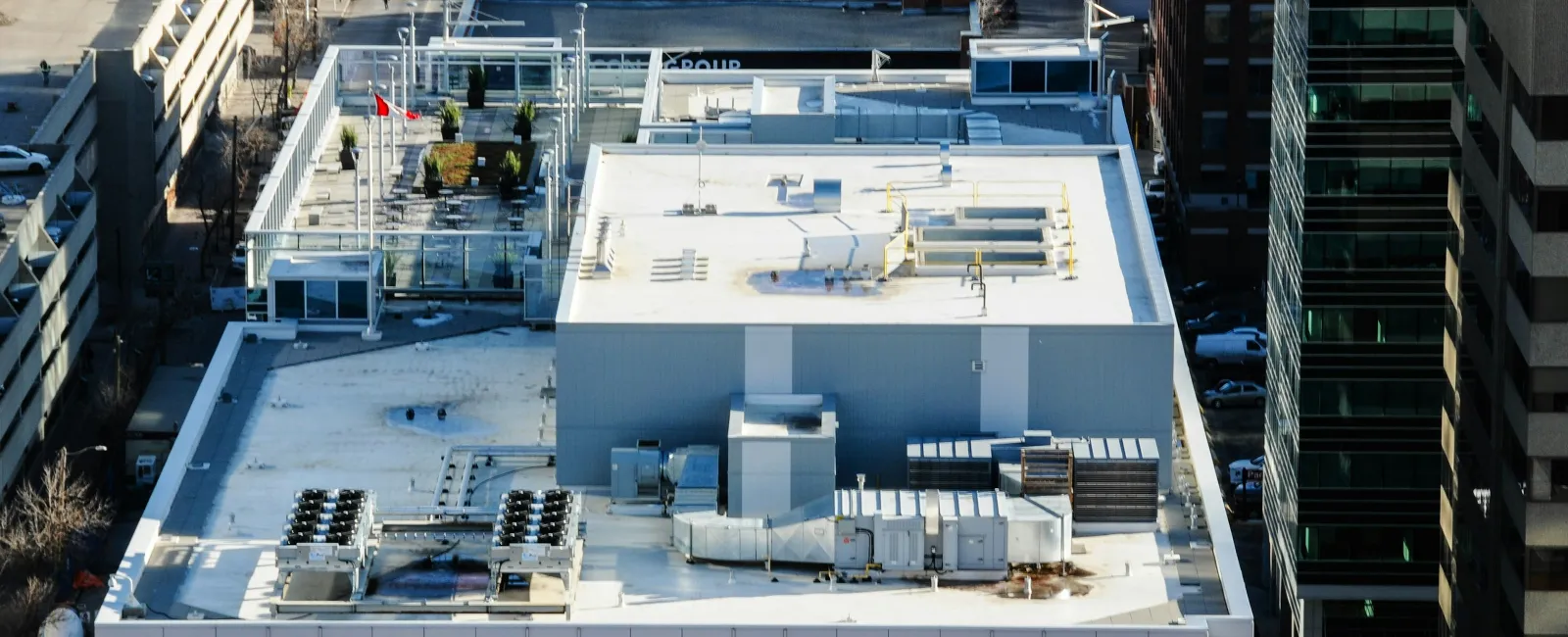
If you own or manage a commercial building, chances are you have a flat roof and may not know exactly what type of roofing system protects your investment. Understanding the different commercial flat roof types helps you make informed decisions about maintenance, repairs, and eventual replacement.
This guide covers the six most common flat roof systems used on commercial buildings, their advantages and limitations, and how to determine which type you have.
Why Flat Roofs Dominate Commercial Construction
Walk through any commercial district, and you'll notice most buildings have flat or low-slope roofs rather than the pitched roofs typical of residential construction. There are practical reasons for this:
- Cost efficiency. Flat roofs require less material and labor to install than sloped roofs, reducing construction costs for large-footprint buildings.
- Usable space. Flat roofs accommodate HVAC equipment, solar panels, and rooftop amenities without the complications of working on a slope.
- Easier maintenance. Technicians can safely walk on flat roofs to perform inspections, maintenance, and repairs, which are critical for buildings with rooftop mechanical systems that require regular service.
- Flexibility. Flat roof systems are used across building types, from warehouses and manufacturing facilities to office buildings and retail centers.
Since 1996, NOVA's building enclosure consultants have assessed thousands of commercial roofs across the Southeast. We've seen every type of flat roofing system and the problems that develop when roofs aren't properly specified, installed, or maintained.
The Six Common Commercial Flat Roof Types
Commercial flat roofs fall into three general categories: single-ply membranes, multi-ply systems, and specialty applications. Here's what you need to know about each.
1. TPO (Thermoplastic Polyolefin)
TPO has become one of the most popular commercial flat roof materials over the past two decades. This single-ply membrane combines polypropylene and ethylene-propylene rubber to create a flexible, heat-weldable roofing sheet.
Key characteristics:
- Typically white or light gray, providing high reflectivity
- Heat-welded seams create strong, watertight connections
- Good resistance to UV radiation, ozone, and chemical exposure
- Typical thickness ranges from 45 to 80 mils
- Expected service life of 15-25 years with proper maintenance
Best applications: TPO works well for buildings prioritizing energy efficiency. The reflective surface reduces cooling loads, making it popular in hot climates. It's commonly found on retail buildings, offices, and warehouses throughout Georgia, Florida, and the Carolinas.
Considerations: TPO formulations have evolved significantly since the material's introduction. Earlier versions experienced premature failures, but current formulations from major manufacturers have proven more reliable. Proper installation—particularly seam welding—is critical to long-term performance.
2. EPDM (Ethylene Propylene Diene Monomer)
EPDM is a synthetic rubber membrane that has been used on commercial roofs for over 50 years. Its long track record makes it one of the most proven flat roof systems available.
Key characteristics:
- Typically black, though white versions exist
- Seams joined with adhesive or tape (not heat-welded)
- Excellent flexibility, even in cold temperatures
- Strong resistance to UV radiation and weathering
- Available in large sheets, reducing the number of seams
- Expected service life of 20-30 years
Best applications: EPDM performs well across climate zones and building types. Its flexibility makes it particularly suitable for buildings that experience thermal movement or structural settling. The material handles foot traffic reasonably well, making it appropriate for roofs with regular maintenance access.
Considerations: Black EPDM absorbs heat, potentially increasing cooling costs in warm climates. The adhesive or taped seams require careful installation and periodic inspection, as seam failures are the most common source of leaks. NOVA's roof assessment services frequently identify seam issues during condition evaluations.
3. PVC (Polyvinyl Chloride)
PVC single-ply membranes have been used on commercial roofs since the 1960s. The material offers excellent chemical resistance and durability.
Key characteristics:
- Typically white or light-colored
- Heat-welded seams (similar to TPO)
- Outstanding resistance to chemicals, grease, and oils
- Inherently fire-resistant
- More rigid than TPO or EPDM
- Expected service life of 20-30 years
Best applications: PVC excels in environments with chemical exposure. Restaurants, food processing facilities, and industrial buildings benefit from PVC's resistance to oils, fats, and other substances that degrade other membrane types. The material also performs well in areas with high fire risk requirements.
Considerations: PVC typically costs more than TPO or EPDM. The material can become brittle over time, particularly in extreme temperature fluctuations. Compatibility issues can arise when PVC comes into contact with certain materials, including asphalt-based products.
4. Modified Bitumen
Modified bitumen (mod-bit) roofing combines traditional asphalt technology with modern polymer modifiers. The result is a multi-ply system that offers durability and redundancy.
Key characteristics:
- Consists of reinforced asphalt sheets with polymer modifiers (APP or SBS)
- Installed in multiple layers for redundancy
- Available in various surface finishes, including granulated, smooth, and reflective
- Can be torch-applied, cold-applied, or self-adhered
- Handles foot traffic well due toits thickness
- Expected service life of 15-25 years
Best applications: Modified bitumen is well-suited for buildings with regular rooftop traffic, maintenance personnel, equipment service technicians, or building engineers accessing mechanical systems. The multi-ply construction provides forgiveness if the top layer is damaged.
Considerations: Torch-applied installation creates fire risk during construction. The material is heavier than single-ply membranes, which may be a factor in buildings with structural limitations. Dark-surfaced mod-bit absorbs heat unless coated with reflective materials.
5. Built-Up Roofing (BUR)
Built-up roofing, often called "tar and gravel," is the oldest flat roof system still in common use. BUR consists of alternating layers of bitumen and reinforcing fabric, topped with aggregate or a cap sheet.
Key characteristics:
- Multiple plies create a thick, durable membrane
- Gravel surfacing protects against UV and provides fire resistance
- Proven technology with decades of performance data
- Excellent waterproofing when properly installed
- Expected service life of 15-30 years
Best applications: BUR remains a solid choice for buildings where proven performance matters more than energy efficiency. The system handles foot traffic well and provides good protection in areas with severe weather. Some building owners prefer BUR for its track record and the availability of contractors experienced with the system.
Considerations: BUR installation involves hot asphalt, which can create odors and require strict safety protocols. The system is heavy, an important consideration for structural loading calculations. Finding the source of leaks can be challenging because water may travel between plies before appearing inside the building.
6. Green Roofs and Specialty Systems
Green roofs, also called vegetated roofs or eco-roofs, incorporate living plants over a waterproofing membrane. While less common than other flat roof types, green roofs are gaining popularity in urban areas.
Key characteristics:
- Consists ofa waterproofing membrane, a drainage layer, a growing medium, and vegetation
- Extensive systems use shallow soil and hardy plants; intensive systems support deeper plantings
- Provides stormwater management benefits
- Reduces the urban heat island effect
- Requires specialized design and maintenance
Best applications: Green roofs work well for buildings seeking LEED certification, stormwater credits, or distinctive amenity spaces. They're increasingly common on corporate headquarters, hospitality properties, and urban mixed-use developments.
Considerations: Green roofs require careful structural analysis to accommodate the added weight, particularly when saturated. The waterproofing membrane beneath the vegetated layer must be robust, as repairs are difficult once the system is installed. Ongoing maintenance is more intensive than conventional roofs.
How to Identify Your Roof Type
If you're not sure what type of flat roof is on your building, a visual inspection can provide clues:
Color and texture. Black rubber-like material suggests EPDM. A white or gray membrane with visible seams indicates TPO or PVC. Gravel surface typically means BUR. Granulated surface may be modified bitumen.
Seam appearance. Wide, smooth seams suggest heat-welding (TPO or PVC). Seams with visible tape or adhesive suggest EPDM. Overlapping layers suggest modified bitumen (BUR).
Age of building. Buildings constructed before 1980 likely have BUR. Buildings from the 1980s to 2000s often have EPDM. Newer buildings increasingly feature TPO.
To definitively identify your roof and understand its current condition, NOVA's building enclosure team can perform a comprehensive roof assessment, including core samples, moisture surveys, and remaining service-life estimates.
Factors That Affect Roof System Selection
When it's time to replace a commercial flat roof, several factors influence which system makes the most sense:
- Building use. Restaurants and food facilities benefit from PVC's chemical resistance. Warehouses with minimal rooftop traffic may prioritize cost efficiency. Buildings with extensive HVAC equipment need systems that handle foot traffic.
- Climate. Reflective membranes like TPO and PVC reduce cooling loads in hot climates. EPDM's flexibility performs well in environments with extreme temperature swings. All systems must accommodate local wind uplift and rainfall requirements.
- Budget. Initial cost varies significantly between systems, but lifecycle cost, including maintenance and expected service life, provides a more accurate comparison. The least expensive installation isn't always the best value.
- Existing conditions. Roof replacement may involve removing the existing system or installing a new system over it. Structural capacity, insulation requirements, and drainage conditions all influence options.
NOVA's roof consulting services help building owners objectively evaluate these factors. We don't install roofs, so our recommendations focus solely on what's best for your building, not what's most profitable for a contractor.
The Importance of Professional Roof Assessment
Regardless of the flat roof type on your building, regular professional assessment extends its service life and prevents costly failures. A qualified building enclosure consultant can:
- Identify the roof system type and its current condition
- Detect moisture intrusion before it causes interior damage
- Evaluate remaining service life
- Recommend maintenance priorities
- Develop specifications for repairs or replacement
- Provide independent quality assurance during roof installation
With nearly three decades of experience assessing commercial buildings throughout Georgia, Florida, North Carolina, and South Carolina, NOVA understands how Southeast climate conditions affect each roof type. Our team has evaluated everything from small retail buildings to large industrial facilities, providing practical recommendations that protect building investments.
Next Steps
Whether you're trying to understand your existing roof, planning for replacement, or dealing with an active leak, NOVA's building enclosure consulting team can help. Contact us to discuss your building's roof and learn how professional assessment supports better decision-making.